|
 |
 |
 |
 |
|
|
|||||||||||
|

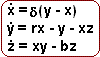
.... In the early 60's many scientists motivated by the climate changes and the increase of CO2 in the atmosphere, got involved with climate modelling. One of them was the Meteorologist Edward Lorenz, a scientist of MIT, who in 1963 used the differential equations of " Navier - Stokes " in order of modelling the evolution of the state of the atmosphere:
Article:
"Deterministic nonperiodic flow", in the
"Journal of Atmospheric Sciences" 20 : 69 ( 1976 )
Where:
x = . Ratio of the
system rotation
y = . Gradient of temperature
z =. Deviation of temperature
d
=. Number of Prandtl: [ viscosity ] / [ thermal conductivity
]
r =. Temperature difference between the base
and the top of the system
b =. Ratio between
the length and the height of the system.
| The big vortexes have got small vortexes |
Starting from certain initial condition (Xo, Yo, Zo) the system of differential equations can be used connected to draw the corresponding trajectory in the space of phase 3D, obtaining the following figure known as " Lorenz Attractor ":

Note: the Lorenz Attractor is a geometrical figure similar to a butterfly
wich
in order to be contained, it needs more than two dimensions and less than
three
(2.06), therefore it is a fractal.
(the inverse of the Exponent of Hurst is equal
to the fractal dimension of
a series of time).
The numeric method of resolution demmands to use the data XYZ in t = n-1 to get the same data in t = n. Fortunately to Lorenz, the data numerically obtained were the same ones to the ones expected for several days, until one morning he decided that he had to save paper and time (we are talking about a "Royal McBee" computer of the 60's), so he used three decimals in the input data instead of using six ... and that was the time when the chaos appeared: The trajectory in the Space of Phase started to follow a different route, very different from the original tendency, which was really new. A small margin of error in the input data take us to diagnose show in summer, and as matter of fact, it could happen in the rel word. Up to that time, the Physicist were used to see that a slight difference in the input data had to cause a slight difference in the output data. For example, to obtain the maximum reach of a projectile it is necessary that the angle can be equals to 45.000... º but nobody cares about the next ten decimals and it does not seem logical to ask for such accuracy. However there are sensitive systems to the initial conditions, like the atmospheric weather, where two points infinitesimally close in Space of Phase can follow totally contradictory trajectories. The technologic margin of precision is always going to be larger than the maths concept of "differential", it can be concluded that it's impossible to make a reliable meteorological prediction in a long term. In spite of this the trajectories have the tendency to be concentrated in certain zones ("attractors"), as a matter of fact it is possible to forecast the global behaviour of the system (example: hot in summer and cold in winter, the two lobes of the Lorenz Attractor). We can also observe that an infinitesimal difference in the initial conditions can be illustrated with a system A of control v/s the same system A with a butterfly fluttering its wings. As we know now that the trajectories in the space of phase can be totally different, we can state that "A butterfly fluttering its wings in Hong Kong can even provoke a tornado in Kansas" (Butterfly Effect).
The Holographic Universe and the Golden Connection
According to the old mechanist paradigm (XVII C) the whole is simply the suming
up or joining of the parts, in a similar way to a clock mechanism. As Isaac
Newton's quoted: "The Universe is simply a gigantic machine". On the
other side, the relatively new paradigm of the Theory of Systems (XX C) recognizes
the sinergy among the parts. Then, the whole is greater than the addition of
its parts: when the parts join together, new connections among them appear,
what generates the appearing of new properties:
i) The human being is not equals to the simple joining up of his organs. The
physical confort depends on a harmonic equilibrium among all the organs of the
human body and not of what happens to every single organ. When we take an aspirin,
this gets dissolved in the blood, affecting by this way the whole body.
ii) If a toxic gas (chlorine) joins a metal (sodium) they generate a substance
that gives a "good taste" to the meat: the salt. The properties of
the salt have not got any relation with the ones of the toxic gas neither with
the ones in a metal.
..... Latest research (ex. the study of hadrons in Physics of Particles) take the systemic hypothesis to more complex levels: the one of the part containing the whole ("Holons"). For example, in the case of the regular fractals, we have that they get their properties (and even their visual effect) in front of the changes in scale.
 |
 |
..... The hypothesis of "The Holographic Universe" tells us that the information of the whole universe is contained in any sub-set of it. So it should be possible to rebuild the whole universe from a simple microbe. In other words: the parts are reproductions on scale of the whole. Or also: the whole is contained in every single part, the same as a hologram. If we chop in many parts the plaque of a hologram, it happens that every section will have the faculty to reproduce by itsellf the original image. One similar idea is outlined in the Sutra Avatamsaka (~ V Century BC):
In the sky of Indra there is a web of pearls ordered in such a way that if you look through one, you will see all the other reflected in it. In the same way, every object of the world is not just itself, but it includes any other single object and it is, in fact, every other [ ... and inside Indra's Tower... ] there are also hundreds of thousands towers [or Universes], every one so exquisitely ornamented like the Main Tower and so spacious like Heaven. And all these towers beyond a number could be calculated, don't absolutely disturb each other; every one preserves its individual existence in perfect harmony with all the rest; there is nothing here that could impede one tower being fusioned with all the rest individually and collectively; there's a state of perfect mixture and, however, of perfect order. Sudhana, the young pilgrim, sees himself in all the towers and in every one of them, where the whole is contained in every one and every one is contained in the whole.
.... The hypothesis that tells that the part contains the whole can be expressed mathematically:

We want that the part be a reproduction to scale of everything, it means:

The equation to solve is: x2 - x -
1 = 0
As x >0:
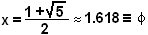
This number is named "Phi" in honour to the greek architect Phidias
and during the Renaissance it was known as the "Golden Number" or
"Divine", because the grees deduce it from demands that joined philosophy,
religion and mathematics.
According to the Greeks, the perfect rectangle
is the golden: 
|
The Holographic Principle
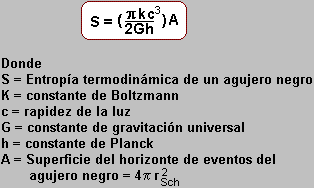
- Let's see that the entropy in a black hole
is proportional to its surface. Also, the black holes are the objects
with the greatest possible entropy. Inference: the information stored
by a black hole is proportional to its surface. ii)Holographic Paradox
|
* Fibonacci's Series
Leonardo de Pisa, aka Fibonacci (XIII Century), traveled around Asia Minor
and got contacts with the greates mathematics of the time. Thanks to them he
realizad that many natural phenomena could be modelled up with the following
series:
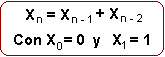
The series outputs the following calues: 0, 1, 1, 2, 3, 5, 8, 13, 21, 34, etc.
Examples
|
i) Pine nut
|
ii) Nautilus's Shell
| ||||||||||||||||
| iii) Spiral Galaxy
|
iv) Biological Example
|
Let's diagram now Q = x(t) / x(t-1) with t >= 2:
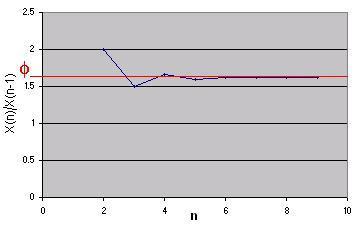
What's the number that the series has tendency to?
Fortuity?
If the Universe wants to tell us something, what would be the language it would
use?
Galileo's answer: "The Universe is written in Maths language".
According to the Astronomer James Jeans: "More than a great machine, the
Universe seems to be a great thought".
CHARACTERIZATION OF THE CHAOS
... The Theory of Chaos allows us to deduce
the subjacent order that the apparently random phenomena hide. It is well known
that the totally determinist equations (like the Lorenz's set) show the following
characteristics that define the chaos:
i) They are redetrminist, it means:
- There is a "law" that rules the behaviour of the system (what's
the opposite to "determinist"? "Random"? or "with free
will"? Is there free will to the hard sciences or is it just an illusion?)
- The phenomenon could be expressed by the "understanding" instead
of doing it through "extension".
- There is a simulation of lower amount (Kb) than the original system that allows
to generate the same data observed.
... It is important to quote that according to
Chaitin (1994) a system is random when the algorythm that its own series generates
uses more Kb than the original system (likewise, the more efficient is to express
the system by "extension" and not through an algorythm)
ii) They are very sensitive to the initial conditions.
An infinitesimal deviation in the starting point causes an exponential divergency
in the trajectory of the Space of Phase, what can be quantified with the "Lyapunov
Exponent".
- The extreme sensibility to the initial conditions makes that the system behaviour
could be indetermined from the "Predictibility Horizon", as the technological
uncertainty is associated to the input data it's always going to be greater
to the concept of "mathematics infinitesimal".
- In spite of the unpredectibilty of a particular trajectory of the Space of
Phase, "Attractors" can be found or zones of the Space of Phase that
tend to be "visited" with more frequency than others.
NOTE: Normally the trajectory of the Space of Phase of a chaotic system generates
a fractal curve (of fractionary dimension)
iii) They seem aleatory or disordered, but finally they aren't:
- They follow determinist equations
- They show attractors
.... An example of determinist but chaotic equations
is:

... The butterfly effect can be illustred comaring
the diagrams that are got when the following initial conditions are used:
System A: Xo = 0.399999
System A + a butterfly: Xo = 0.400000 (just a millionth of
difference)

... Some Mathematic
tools that allow us to study the chaos are:
i) Hurst's Exponent (H)
A number that indicates the influence degree from the present over the future
(degree of similitude of the phenomenon with the "Brownian Movement"
or "Aleatory Walker".
Possibilities:
- H > 0.5: Persistent system (positive correlation). Example: If H = 0.7,
then there is a 70% possibility that the following member in the series shows
the same trend that the actual member.
- H = 0.5: Aleatory system (null correlation or "blank noise")
- H < 0.5: Antiperistent system (negative correlation)
ii) Relative Complexity of Lempel Ziv (LZ)
It is a valuation of the algorythmic complexity degree that it should present
a simulation capable to represent faithfully and accurately the phenomenon.
It is calculated through the Kaspar and Schuster algorythm.
Possibilities:
LZ = 1.0 = Maximum complexity (aleatory series)
LZ = 0.0 = Perfectly predictable series.
|
"[That the trajectories of the Space
of Phase have] sensitive dependency of the initial conditions means
that they have tendency to separate themselves James Gleick |
iii) Greater Exponent of Lyapunov (L)
It is a valuation of the maximun divergency ratio between two trajectories of
the Space of Phase of which initial conditions difere infinitesimally. The units
are bits per unit of time (in 2 base) and they are calculated with the algorythm
of wolf.
Possibilities:
- L < = 0: periodic series
- L > 0: chaotic series
- L ---> oO : aleatory series
iv) Informatic Entropy
It is an indication of the degree of disorder of the data an it is calculated
adding up the positive exponents of Lyapunov in e base (algorythm of Grassberger
and Procaccia).
End of the series

Home: www.geofisica.cl
| Chaos Theory 2005
| HOME UltraModern Physics PRODUCTS |
Intelectual Property Register Nº
148.917
|