Geólogos revelan que en Chile
se esconde la mayor reserva de hielo combustible del mundo
Fuente: El
Mostrador
El estudio, publicado por la revista “Marine and Petroleum Geology”, titulado “A first estimation of gas hydrates offshore Patagonia (Chile)”, advierte que, pese a ser el gas metano una posible fuente de energía en el futuro, tras un terremoto, la liberación de este gas desde los fondos marinos podría magnificar los efectos de un tsunami.


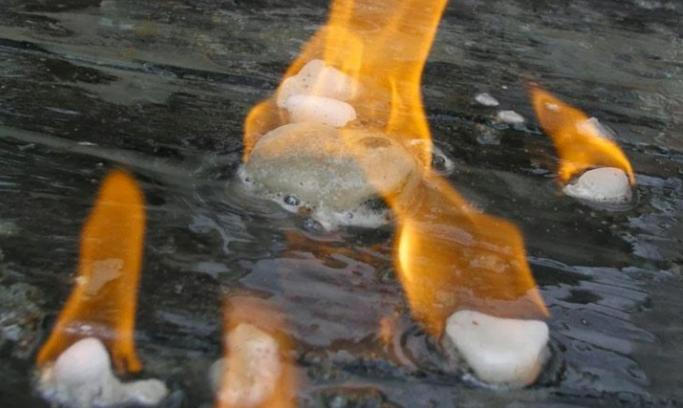
Enormes reserva de hidratos de metano en la Patagonia


Paper: A
first estimation of gas hydrates offshore Patagonia (Chile)
Authors: Lucía Villar-Muñoz, Joaquim P. Bento, Dirk Klaeschen,
UmbertaTinivella, Iván de la Cruz Vargas-Cordero, Jan H. Behrmann.
Abstract
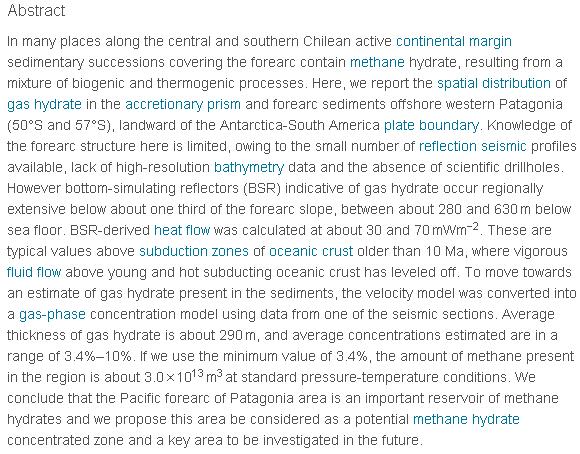
In many places along the central and southern Chilean active continental
margin sedimentary successions covering the forearc contain methane hydrate,
resulting from a mixture of biogenic and thermogenic processes. Here,
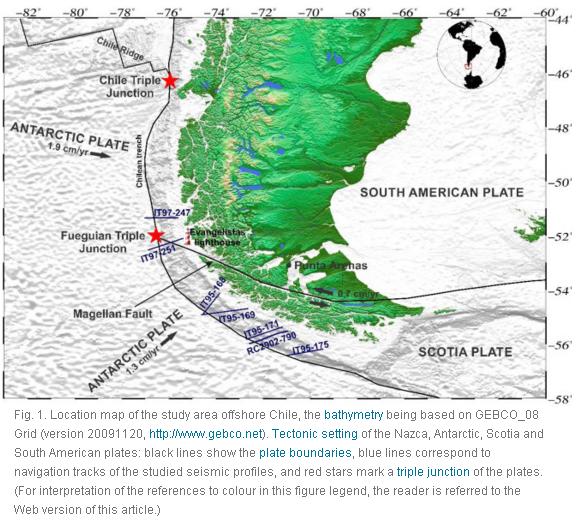
we report the spatial distribution of gas hydrate in the accretionary
prism and forearc sediments offshore western Patagonia (50°S and 57°S),
landward of the Antarctica-South America plate boundary. Knowledge of
the forearc structure here is limited, owing to the small number of reflection
seismic profiles available, lack of high-resolution bathymetry data and
the absence of scientific drillholes. However bottom-simulating reflectors
(BSR) indicative of gas hydrate occur regionally extensive below about
one third of the forearc slope, between about 280 and 630 m below sea
floor. BSR-derived heat flow was calculated at about 30 and 70 mWm-2.
These are typical values above subduction zones of oceanic crust older
than 10 Ma, where vigorous fluid flow above young and hot subducting oceanic
crust has leveled off. To move towards an estimate of gas hydrate present
in the sediments, the velocity model was converted into a gas-phase concentration
model using data from one of the seismic sections. Average thickness of
gas hydrate is about 290?m, and average concentrations estimated are in
a range of 3.4%–10%. If we use the minimum value of 3.4%, the amount
of methane present in the region is about 3.0×10¹³ m3 at standard
pressure-temperature conditions. We conclude that the Pacific forearc
of Patagonia area is an important reservoir of methane hydrates and we
propose this area be considered as a potential methane hydrate concentrated
zone and a key area to be investigated in the future.