Contact
us!
Contact
us!GWP - ELECTRIC PROSPECTING
|
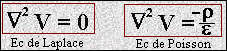
VISUALIZING THE SUBSOIL WITH LAPLACE AND POISSON EQUATIONS
|
|
|
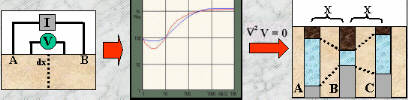
VERTICAL ELECTRIC SOUNDING (VES)
A VES allows to get 1D information of the soil through the application of pulses of current as stimulus and the simultaneous register of the difference of potential generated as a way of response. Using Laplace equation is possible to deduce the stratigraphic profile. Starting from a set of data "stimulus/response" gotten in the outdoor work. Notes:
|
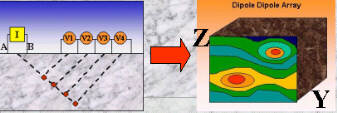
DIPOLE DIPOLE ARRAY (DDA)
The DDA gives 2D information of the soil which is very used in mining to detect zones with high concentration of metallic minerals. The phase of the soil generates an "apparent" map of the subsoil, which must be converted into a "real" map using Laplace equation. Notes:
|
|
IP-Res Study
|
||
| Concept: The application of electric current to the field and the reception in the form of a potential difference. Therefore, the field configuration is deduced through Maxwell's equation. | ||
|
Methods
|
Applications
|
|
|
MORE: |
|
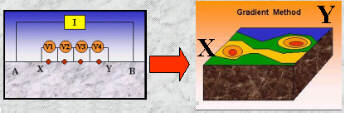
ELECTRIC METHODS OF PROSPECTING Some geoelectric methods measure the electric fields generated spontaneously in the Earth crust. Others measure the electric fields artificially generated due to the application of an electric current (continuous or alternating) of low frequency (about 10 Hz). i) The Resistivity Method used in mining, geology and hydrology,
allows to study the anomalies of electric resistivity, what can be
correlated with the presence or absence of mineralized volumes. ii) The Method of Induced Polarization quantifies the capacity properties of the Earth crust (presence of "mini-condensators") as it could be the case of sulphurs diseminated. | See Aplication iii) The Autopotential Method is related with the natural currents present in the Earth crust due to spontaneous chemical reactions and to the presence of underground water (NOTE: During 2003, Daniel Kwok, Larry Kostiuk et al discovered that the water flows create an electric current)
|
|
|
Companies
that do Geoelectric Prospecting
|
|||
 Geodatos |
 |
 |
 |
|
RESISTIVITY
VALUES FOR COMMON ROCKS (Ohm*m) |
|
MYSTERY |